
Sub-Total: $0.00
How to Fix Sticky Sourdough (7 Secrets for Soft, Airy Bread)
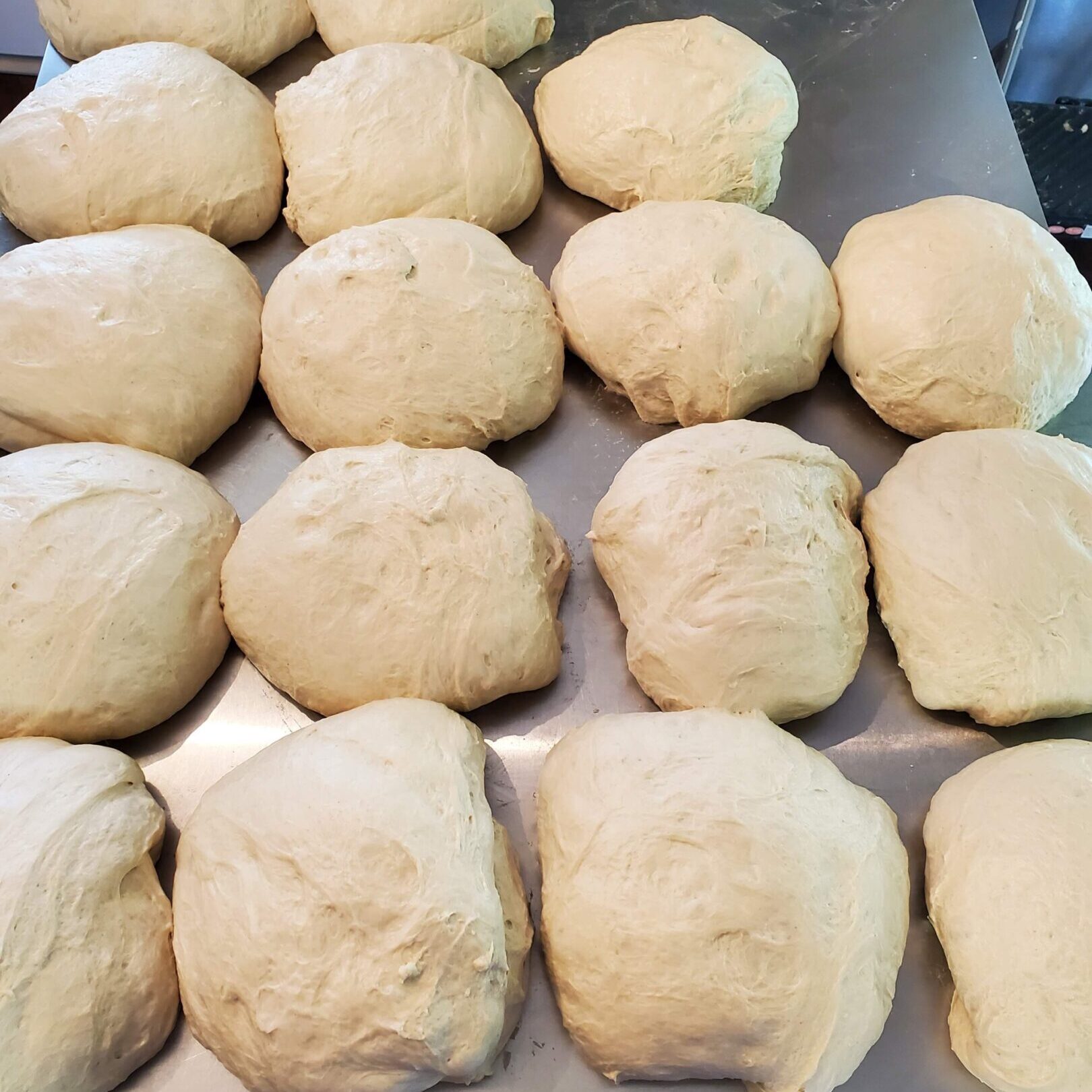
👉If you’ve struggled with sticky dough or flat loaves, I’m going to walk you through exactly how to fix it. With some tried and true methods from my home bakery.
If your sourdough dough is too sticky, hard to shape, or not rising properly—you’re not alone. The issue usually comes down to a few key factors like flour strength, starter health, and fermentation timing. The good news is—these are all fixable.
Most beginner struggles don’t come from complicated techniques. They come from a few key things that are often overlooked.
These are the exact methods I use to get dough that is strong, airy, and easy to handle—whether I’m making a couple loaves or 60+ loaves a week.
1️⃣ Ingredients Matter More Than You Think
The type of flour you use can completely change your dough.
If you’re using all-purpose flour, your dough will behave very differently than if you’re using a high-protein bread flour. Lower protein flours tend to create dough that is softer, stickier, and harder to build strength.
If you want dough that is:
- Easier to handle
- Less sticky
- More airy and structured
👉 You’ll get much better results using bread flour.
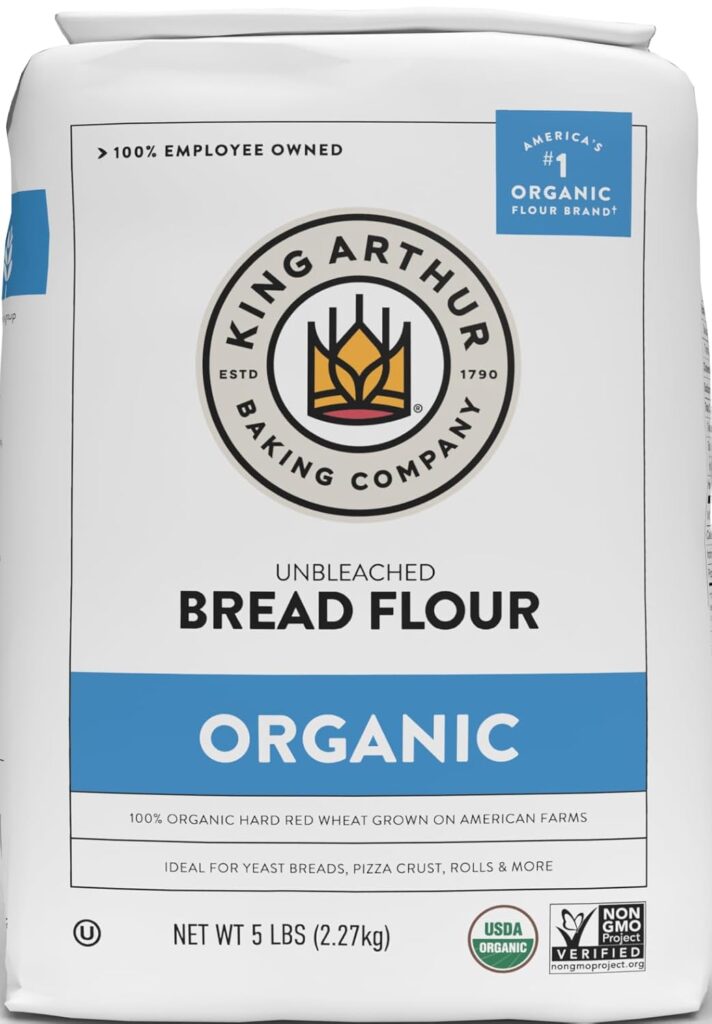
My personal favorite is King Arthur Baker’s Classic organic bread flour. It has a strong protein content (around 12.7%) and performs very consistently for me.
A Slightly Unconventional Approach (That Works Really Well)
I also do something a little different…
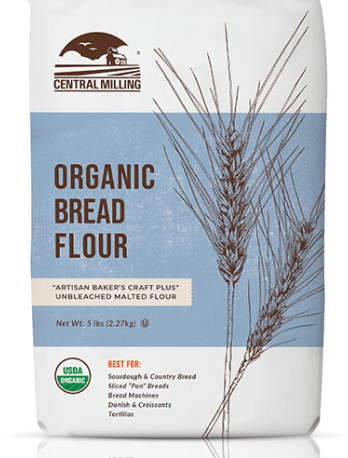
I feed my starter with Central Milling Organic Artisan Bakers Craft flour (about 11.5% protein), but I make my bread using King Arthur.
Is this necessary? Probably not. But it’s worked extremely well for me, and I like to be transparent about that.
If you’re thinking that sounds a little odd—you’re not wrong 😄
I originally used Central Milling for everything. It’s a great flour. But I started running into supply issues and couldn’t get it consistently, so I needed a reliable alternative.
That’s when I switched to King Arthur for baking. I was able to source it easily in bulk, and I loved how the dough performed—so I stuck with it.
At the same time, I still had Central Milling on hand for feeding my starter… and honestly, I didn’t want to mess with something that was already working well. So I never switched it.
And that’s the whole story.
Another Optional Feeding Tip (but highly recommended): Adding Rye Flour
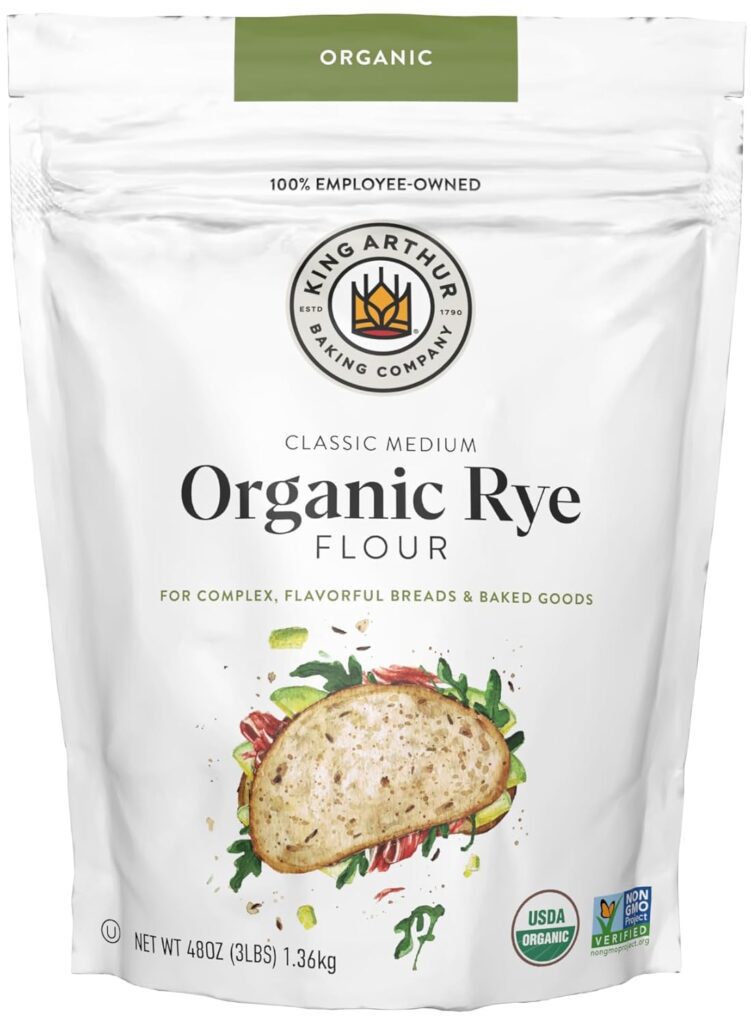
To keep my starter extra healthy, I always add a small amount of organic rye flour to feedings. The amount I add is always 1/3 the total amount of flour. So as you can see in the example below, I am feeding 120g of flour so 40g of that is rye flour.
For example:
- 30g starter
- 40g rye flour
- 80g bread flour
- 120g water
Rye flour contains additional nutrients that wild yeast loves.
This step isn’t 100% necessary, but it can help strengthen fermentation over time. I really think this is one of the key things that I do to keep my starter so happy and healthy 😊.
Why This Might Actually Help
Flour is the main source of yeast and bacteria in your starter.
Using different flour to feed your starter than what you use to make your dough may actually introduce more diversity into your starter. That diversity can help create a stronger, more resilient fermentation.
💡 Takeaway
If your dough feels sticky, weak, or hard to work with:
👉 Switching to a higher protein bread flour can make an immediate difference.
And if you want to experiment a bit, even introducing some variety in the flour you use to feed your starter may help strengthen it over time.
When you’re baking multiple loaves every week, you quickly learn what actually makes a difference—and what doesn’t.
2️⃣ Your Starter Might Be “Active”… But Not Strong
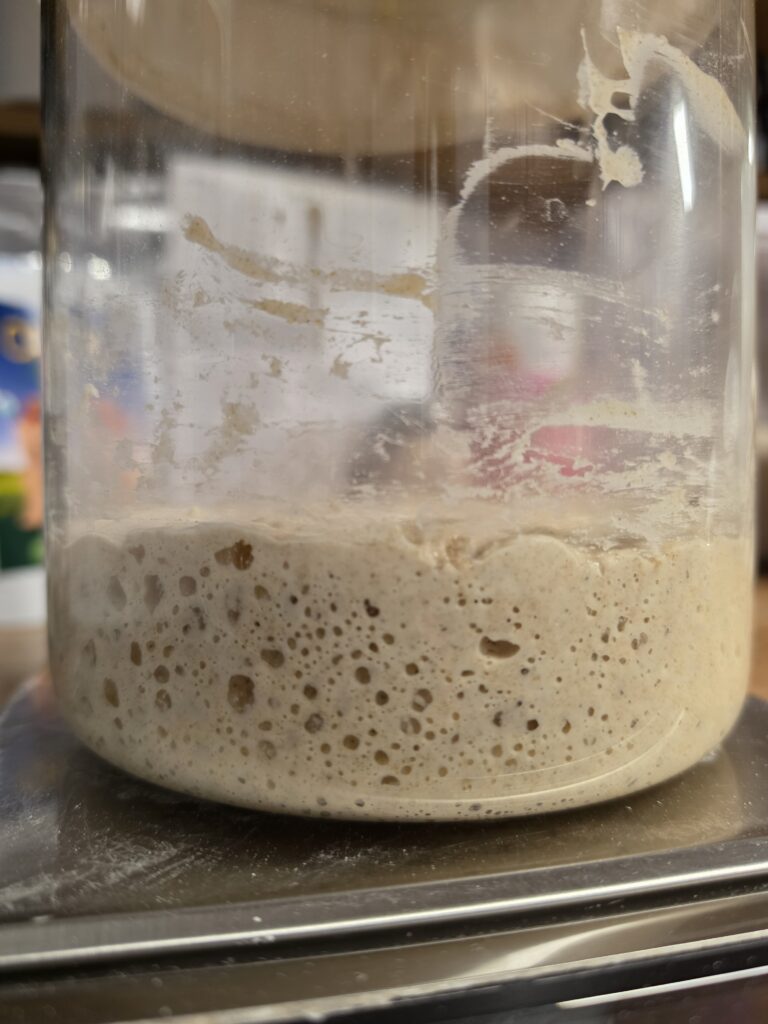
Your starter can look perfectly fine—bubbly, rising, even doubling—and still not be strong enough to make great bread.
This usually comes down to balance.
A starter can have more lactic acid bacteria than yeast. When that happens, you may see what looks like a good rise, but it doesn’t provide the strength needed for proper fermentation.
This often leads to:
- Sticky dough
- Poor structure
- Dense or gummy bread
This is especially common with newer or recently established starters.
Why This Happens
Over time, your starter will naturally strengthen as the yeast population grows—but how you feed and maintain it plays a huge role in how well it performs.
If you want a deeper dive into feeding, maintenance, and troubleshooting, I break it all down here:
👉 How to Care for a Sourdough Starter
A Fun (and Slightly Gross) Fact
Every sourdough starter is completely unique.
In one study, researchers gave identical starters to different bakers. Over time, each one became significantly different based on its environment—and more specifically, the microbes from the baker’s hands. This just goes to show you, no two starters are alike—even if you got a starter from a friend or bought a dehydrated starter, eventually it changes based on its environment and the baker 😉.
Kind of wild… and a little gross 😄
But also really fascinating.
If you’re into the science side of sourdough, you can read more about it here:
💡 Takeaway
A bubbly starter doesn’t always mean a strong starter.
👉 What really matters is having enough active yeast to properly ferment your dough.
And that strength comes from consistent feeding, good ingredients, and time.
If you’re just getting started and don’t have an established starter yet, it can take a couple of weeks to build strength.
If you’d rather skip that process, you can also start with a mature, active starter (I’ve linked mine below).
3️⃣ My Double Feeding Method (How to Build a Strong Starter)
If there’s one thing that improved my sourdough the most, it’s this:
👉 I double feed my starter before baking.
Instead of feeding once and using it, I feed it twice within 24 hours—with no discard in between.
This builds a much stronger, more active starter and makes a noticeable difference in how your dough performs.
☀️ First Feeding (Morning – Around 10–11 AM)
Start small and intentional using a 1:1:1 ratio.
This allows your starter to peak within a few hours and prepares it for the final build later in the day.
📏 Feeding Comparison
| Ingredients | Small Batch (Home Baker) | Large Batch (My Method) |
|---|---|---|
| Starter | 10g | 83g |
| Water | 10g | 83g |
| Flour | 10g | 83g |
| Total After Feeding | 30g | ~250g |
👉 No discard after this feeding
🌙 Second Feeding (Evening – Around 6–8 PM)
Take your entire starter from the first feeding and build it into your final amount using a 1:4:4 ratio.
This gives your starter enough food to rise steadily overnight without over-peaking.
📏 Feeding Comparison
| Ingredients | Small Batch (Home Baker) | Large Batch (My Method) |
|---|---|---|
| Starter (no discard) | 30g | 250g |
| Water | 120g | 1,000g |
| Flour | 120g | 1,000g |
| Total Starter | 270g | ~2,250g |
This typically peaks in about 10–12 hours.
👉 If your kitchen is warm, you can increase the ratio slightly (like 1:5:5) to slow things down.
🧠 Simple Takeaway
No matter the batch size:
- First feeding = 1:1:1 (quick boost)
- Second feeding = 1:4:4 (overnight strength build)
- No discard between feedings
Want to learn more about the method? Check out my article:
👉 The Double Feed Method: My Sourdough Starter Prep Routine
Don’t want to do the math yourself?
That’s exactly why I made my Double-Feed Sourdough Starter Calculator. 😊
Whether you’re making one or two loaves or a large batch, just enter the amount of starter you need, your extra-starter amount, and your desired mixing time. The calculator handles the feeding amounts and the timing for you.
👉 Get the Double-Feed Sourdough Starter Calculator →
• Instant digital download •
💡 Why This Works
Feeding twice:
- Strengthens the yeast population
- Balances bacteria
- Creates a more powerful fermentation
When it comes to sourdough, fermentation strength matters far more than fancy techniques.
🧺 Helpful Setup Tip
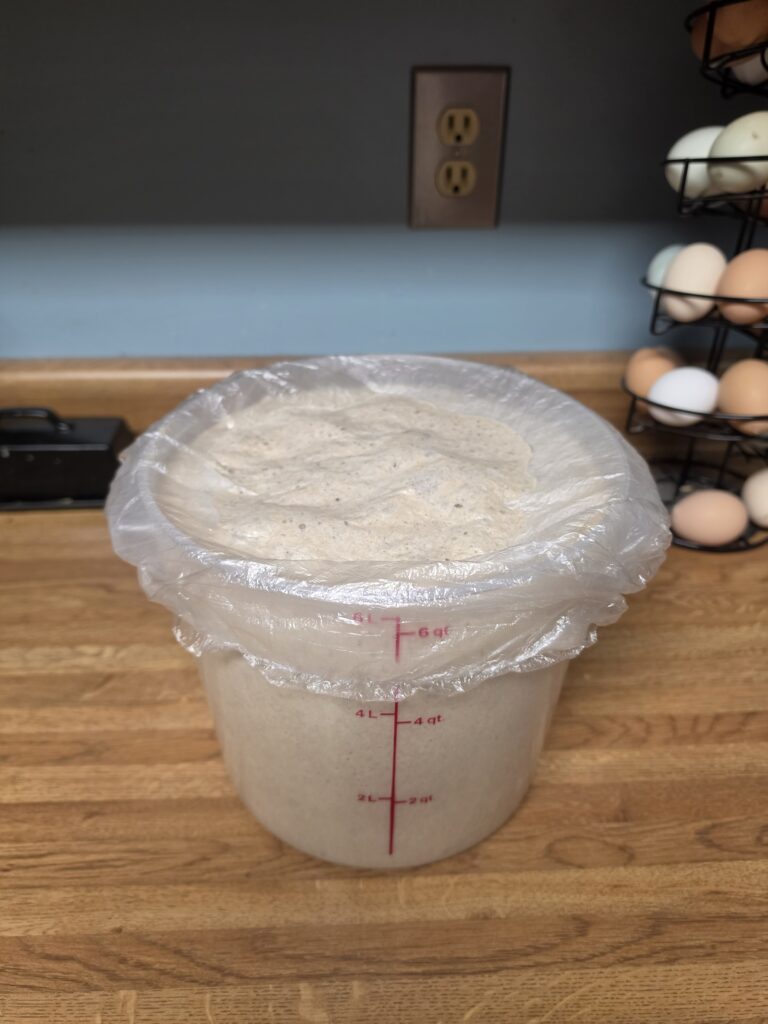
If you’re making larger batches, having a container with enough room makes a big difference. I use a Cambro-style container that comfortably holds my full starter build without worrying about overflow.
I’ve linked the container I use here if you want something similar.
4️⃣ Water Temperature and Quality (A Small Detail That Makes a Big Difference)
Water might seem like a small detail, but it can have a noticeable impact on how your dough develops.
In the winter, I always mix my dough with room temperature or slightly warm water (around 75–80°F).
This gives fermentation a gentle head start without pushing things too fast.
- In normal/cooler conditions → use slightly warm water
- In hot weather → use cooler water to slow things down
Your dough temperature will naturally adjust during fermentation, but starting slightly warm in cool weather helps get everything moving and starting cold in the summer helps keep everything under control.
🌡️ How I Warm My Water
To get the right temperature in the winter, I keep it simple.
I use an electric tea kettle on a low setting (around 120°F), then mix a small amount of that hot water into cooler filtered water until it feels slightly warm to the touch.
No thermometer needed—just go by feel.
I’ve linked a similar teapot to the one I use here.
👉 Teapot
💧 Does Water Type Matter?
For water, I personally use reverse osmosis water that’s been re-mineralized.
Is this necessary? Probably not 😄
But I like having control over my ingredients, and it works well for me.
That said, the main thing you want to avoid is heavily chlorinated water, since chlorine can interfere with your starter and fermentation.
Better options:
- Filtered tap water
- Spring water
💡 Takeaway
- Slightly warm water helps kickstart fermentation
- Cooler water slows things down when needed
- Avoid heavily chlorinated water for best results
Simple adjustments here can make your dough more predictable and easier to work with.
5️⃣ Stretch & Folds (Building Strength the Right Way)
For most home bakers, simple stretch and folds are one of the easiest and most effective ways to build strength in your dough—no kneading required.
During this stage, you’re helping develop gluten, which is what gives your dough structure and allows it to hold air and rise properly.
⏱️ My Simple Method
Here’s what I recommend:
- 3-4 sets total
- 30 minutes apart
That’s it.
After your final set, let the dough rest for the remainder of bulk fermentation.
🖐️ How to Do a Stretch & Fold
- Wet your hands slightly (this helps prevent sticking)
- Gently grab one side of the dough
- Stretch it up and fold it over itself
- Rotate the bowl and repeat 3–4 times
You’ll notice the dough start to tighten and become smoother with each set.
👀 What to Look For
As you go through your stretch and folds, your dough should:
- Feel stronger and more elastic
- Become less sticky over time
- Hold its shape a little more each round
If your dough still feels very loose after your folds, don’t panic—it will continue to strengthen during the rest of bulk fermentation.
🧺 Small Batch vs Large Batch
If you’re making just 1–2 loaves, stretch and folds work perfectly.
For larger batches, I like to use coil folds—they’re a little gentler and easier to manage with bigger amounts of dough.
💡 Takeaway
👉 More folds doesn’t necessarily mean better dough—proper timing matters more than quantity
Consistent, spaced-out folds will build strength far more effectively than doing too many all at once. The dough needs to rest between stretches to allow the gluten to relax and develop.
6️⃣ Dough Temperature & Bulk Fermentation (Why Your Dough Isn’t Rising Right)
Temperature plays a huge role in how your dough develops—and it’s one of the biggest factors in getting consistent results.
Personally, my ideal dough temperature during bulk fermentation is:
👉 74–76°F
At this temperature:
- Bulk fermentation is steady and predictable
- Dough develops strength and structure without overproofing too quickly
⏱️ What Is Bulk Fermentation?
Bulk fermentation is the time between the initial mixing of your dough and shaping it.
This is when:
- Your dough rises
- Gluten continues to develop
- Flavor builds
Getting this stage right makes a huge difference in how your final loaf turns out.
⏱️ A Typical Timeline (At This Temperature)
When my dough is in this temperature range, here’s what my process usually looks like:
- First 2 hours → Mixing + stretch and folds
- Next ~5 hours → Bulk fermentation
- Around the 7-hour mark → Dough is ready to shape
👀 What to Look For (Don’t Just Watch the Clock)
Instead of relying only on time, look for these signs that your dough is ready:
- Dough has risen noticeably (about 75%)
- Surface looks slightly domed
- Edges begin to pull slightly from the bowl
- Dough feels lighter, airy, and jiggly
👉 If your dough is still dense or tight, it likely needs more time.
🧺 Small Batch vs Large Batch (Important!)
This is something many people don’t realize:
- Small batches → stay cooler → ferment slower
- Large batches → generate their own heat → ferment faster
When you’re making larger amounts of dough, the fermentation activity creates warmth, which speeds things up.
On the flip side, smaller batches (1–2 loaves) tend to stay cooler and can lag behind.
🔥 Helping Your Dough Stay Warm
If you’re working with a small batch—especially in cooler months—you may need to give your dough a little help.
I sometimes use a dough heating mat underneath my bowl to maintain a steady temperature.
I’ve linked the one I use here if you need a simple setup.
Even something as simple as a warm spot in your kitchen can make a big difference.
💡 Takeaway
- Temperature controls how fast (or slow) your dough ferments
- Warmer dough = faster fermentation
- Cooler dough = slower, more forgiving fermentation
👉 When you dial in your dough temperature, everything else becomes much easier to manage.
7️⃣ Shaping, Rest, and Cold Proof (Setting Up a Better Bake)
Once bulk fermentation is complete (usually about 7 hours for me in the winter and a little less in the summer), I:
- Shape the dough
- Transfer it to a banneton
- Let it rest at room temperature
- Then move it to the refrigerator
From mixing to the fridge, my process typically takes 8–8.5 hours.
⏱️ After Shaping: What to Expect
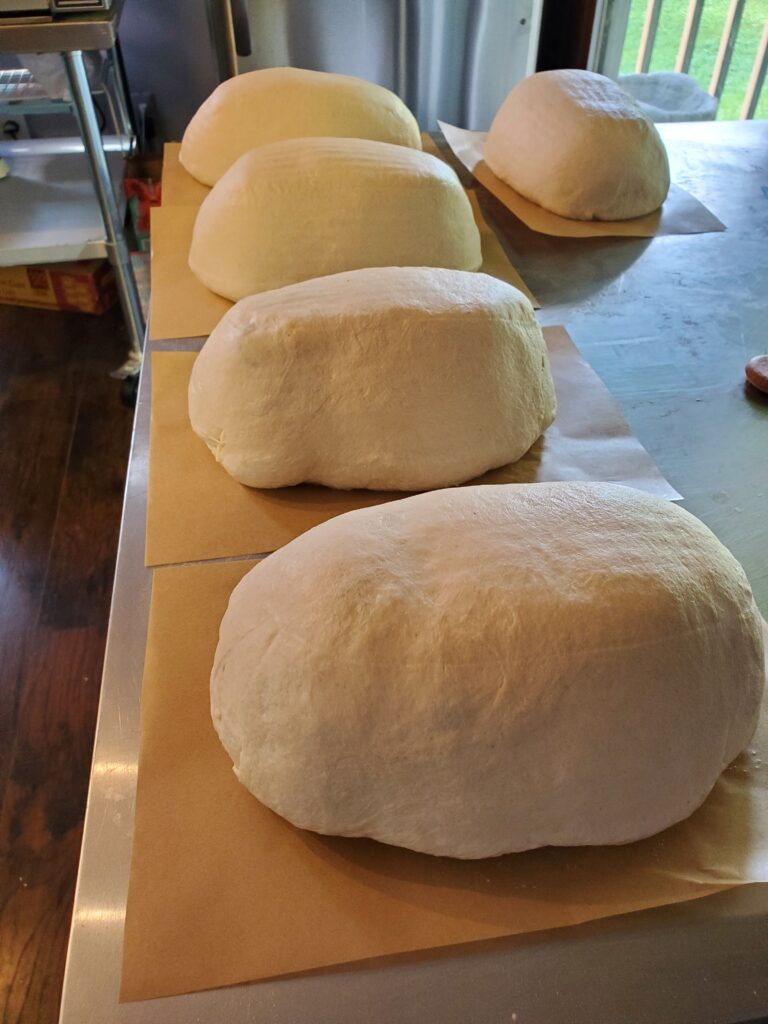
After shaping, I let my dough rest in the banneton at room temperature for about 1–1.5 hours before refrigerating.
👀 Learning to Read Your Dough
This is where experience—and a little bit of gut instinct—comes into play.
I don’t rely on the clock alone. Instead, I’m watching the dough:
- Is it puffy and slightly airy?
- Does it have a nice domed appearance in the basket?
- Is there a jiggle to it when you shake the basket?
Those signs tell me it’s ready for the refrigerator.
🌡️ Dough Temperature Matters
The temperature of your dough also plays a huge role in how long I let it rest after shaping.
For my dough:
- If it’s 76°F or below before shaping, I’ll usually let it rest closer to 8.5 hours total before refrigerating.
- If it’s 77°F or warmer, it’s usually ready closer to 8 hours—or even sooner on a hot summer day.
Warmer dough ferments faster, so it needs less time.
🏠 Home Baker vs. Microbakery
This is something many recipes don’t mention.
If you’re baking one or two loaves at home, your dough will cool down fairly quickly once it goes into the refrigerator.
But in my bakery, I’m often putting dozens of warm loaves into the fridge at the same time. That warm dough raises the refrigerator’s temperature, so it takes much longer for every loaf to cool.
That’s why, as a microbakery owner, I have to think ahead. The more warm dough I load into the fridge, the greater the chance of over-proofing if I don’t account for that extra fermentation time.
In some situations, I’ve even adjusted my refrigerator temperature to help the dough cool more quickly.
Managing this becomes another variable when you’re baking at a larger scale.
💛 Give Yourself Grace
This part of sourdough takes practice.
Learning to judge dough by how it looks, feels, and responds is a skill that develops over time.
And I’ll be honest—even after baking tons of sourdough every week, I still misjudge it once in a while. 😉
💡 My Advice (Especially for Beginners)
Keep it simple.
👉 Let your shaped loaf rest for about 1 hour before refrigerating and see how it bakes.
Then make small adjustments:
- If you wanted more rise or better oven spring, let it rest about 15 minutes longer next time.
- If the dough felt over-proofed or lacked strength, shorten the rest by about 15 minutes.
Small changes are much easier to evaluate than big ones.
Remember, sourdough is part science and part experience. Every loaf teaches you something, and over time you’ll start trusting your dough more than the clock.
🌙 Optional: Overnight Method (Perfect for Busy Schedules)
If you don’t have time during the day, you can easily shift this process to the evening:
- Mix dough at night
- Do 2–3 stretch and folds
- Let it ferment overnight in a cool space
- Shape in the morning and refrigerate
From there, you can bake whenever it fits your schedule.
💛 Final Thoughts
If your sourdough dough has been sticky, weak, or frustrating to work with—it’s not you.
It’s usually one (or a combination) of these things:
- Flour quality
- Starter strength
- Fermentation timing
- Temperature
Once you dial these in, everything gets easier.
And the best part?
👉 You don’t need complicated techniques—just consistency and a few key adjustments.
Continue Your Sourdough Journey
👉Simple Farmhouse Sourdough Bread Recipe (Beginner-Friendly + Digestible)
Learn the full beginner-friendly process for mixing, fermenting, shaping, and baking sourdough bread.
👉 How to Get a Better Rise in Sourdough Bread
Discover the simple changes that can dramatically improve oven spring, loaf height, and crumb structure—without changing your recipe.
👉How to Care for a Sourdough Starter
Feeding, Maintaining, and Preparing It for Baking
Let’s Chat
Have you struggled with sticky sourdough dough?
Tell me what’s been the hardest part—I’d love to help!
22 responses to “How to Fix Sticky Sourdough (7 Secrets for Soft, Airy Bread)”
-
I tried this recipe today and this was the first time I’ve used bread flour for the loaf. I usually let it sit for 2 hours after folds and then shape and into fridge. But you’re looked so good that I had to try. Well…. Something went wrong during fermentation. All I had was a sloppy sticky mess I could do nothing with. Maybe I over fermented?? I’m going to try again using King Arthur, and double feeding to see if that helps. Broke my heart lol. Back to the drawing board.
-
Oh no! Dang….how long do you think you left it out? Was it warm in your house?
-
-
I’m new . Trying my 3rd recipe and still not having any luck. I’ve been bulk fermenting for 8 hours – daytime – and still very little rise , a little puffy, jiggly , but does not pull away from bowl.
How important is it to use my starter at peak . It had fallen some but I decided to use it anyway (I missed the peak by an hour or two ? Really not sure )
I don’t know what to do
With my dough tonight .-
Hi, Using your starter right at peak is not super important. I actually prefer to use mine after it has started falling a bit, so that shouldn’t be a problem. How old is your starter? If it’s new, it may just need more time… if you start form scratch it can take 1-3 months to actually have a robust starter that makes good loaves.
-
-
This is so helpful! Thank you!
Will try it tomorrow. I’ve had some great loaves, but suddenly a bunch of flat dense ones. If I left my starter in the fridge while I got my nerve back up to try again, does that effect feeding before baking? And if I plan to travel for a few months, what do I do with my starter and how do I “bring her back to life”?-
Yay! I’m glad you found it useful. If your starter has been in the fridge a while it could take a little bit to wake up and be very active. I would try my double feeding method and see if that helps. So start with a very small amount, feed 1:1:1 around midday and then don’t discard any and feed 1:4:4 before bed. Your starter should be nice an active by the morning. This would be the same method I would use to wake it up after a vacation.
-
-
Hie your post is super informative and thank you for all your kind knowledge
Also pls share the secrets of oven pizza stone or steel using these things are important for baking.
Maintaining proper Steam supply
Preheat for 40/50mins
Pls share some expert experience on all these points Pls
Thank you -
You said to leave the shaped dough in the banneton for 1 hour before putting it in the refrigerator. Doesn’t it over-ferment? What is the purpose of this?
-
Thanks for all the information. Do you feed your starter by stirring it by hand? Do you use a wooden spoon or do you use a metal spoon when stirring? Also, do you knead your bread by hand or do you use a spiral or planetary mixer?
-
Hi, I usually use a silicone spatula or wooden spoon when mixing my starter and I stir it by hand. I also mix all my dough by hand, I don’t have a spiral mixer.
-
-
Can self rising flour be used in making sourdough bread?
-
No, self rising flour contains baking powder which alters the pH balance and inhibits wild yeast. Your starter will not perform how it’s suppose to if you use self rising flour.
-
-
Such good information, thank you! I’m just starting to make a starter. You said Rye is good to use, can you use whole wheat instead? Do you have a guide or recipe for making a starter?
-
Hi! Rye is a bit better for giving your starter a boost and the right beneficial yeast and bacteria but whole wheat would be helpful as well. I would recommend a combination of bread flour and rye or bread flour and whole wheat. Sorry I don’t have a guide for starting a starter from scratch but there is a good on on the Clever Carrot Sourdough site.
-
-
I’m still confused about feeding my starter. Say I have about 125g of starter, how much flour and water do I give it?
-
It really depends what you plan to do with it…Unless you are planning on baking a lot of loaves of bread, the first thing I would do is discard some of that. Starting with 125g just to maintain, is a little much. I would discard and just leave 20g in the jar. Then I would feed that a 1:4:4 ratio. So, 20g starter: 80g flour: 80g water. That should keep your starter fed for the day if you are leaving it on the counter. If you want to store it in the fridge this feeding should be good for a couple weeks. Just put it in the fridge right after feeding. Hope this helps!
-
-
Wow so much useful information! Thank you.
My only question refers to the following;
7️⃣ SHAPING, REST, AND COLD PROOF (SETTING UP A BETTER BAKE)
Once bulk fermentation is complete (usually about 7 hours for me in the winter and a little less in the summer), I:Shape the dough
Transfer it to a banneton
Let it rest at room temperature
Then move it to the refrigerator
From mixing to the fridge, my process typically takes 8–8.5 hours.when you say “shape” the dough and put in banneton, I’m a bit lost. Do you shape into a ball and do a caddy clasp or allow it to sit rest and then fold, roll up and place?
Also I noticed you do stitch Is that all just understood to most bakers? I do it sometimes and notice THEN it’s a bit sticky instead of pillowy like yours!
Thanks i. advance.-
Hi! Good questions, I decided to add my shaping video to the article. If you refresh the page it should be in the shaping section now 😊. You can use whatever technique that you like, but this is what works for me right now. I shape and place it in the banneton and then wait about 15 minutes to stitch it. If you try to stitch right away after shaping the dough will be too tight and not hold. I find the stitching to be important but it depends on your shaping technique. Mine tend to unroll a bit after shaping so that final stitch brings them back together. Hope that helps answer your questions 👍.
-
-
If I am baking individual bread rolls shoud I shape them individually or shape the dough as a whole and then score to give dividion for “breaking off” after they are baked?
-
Hi! I would shape them individually in round balls and then set them in your pan 👍.
-
-
Thank you for all the generous information and advice! What size are the oval bannetones you use? They look deeper than the regular ones I’ve seen on Amazon.
-
Hi! Glad you enjoyed the article 😊. I use 10 inch ovals here’s the link to my favorites 10 inch bannetons. I do have a few different brands that I got over the years so my collection varies in size a bit, but these are my go to.
-


Tags: Education

Leave a Comment