
Sub-Total: $0.00
Simple Farmhouse Sourdough Bread Recipe
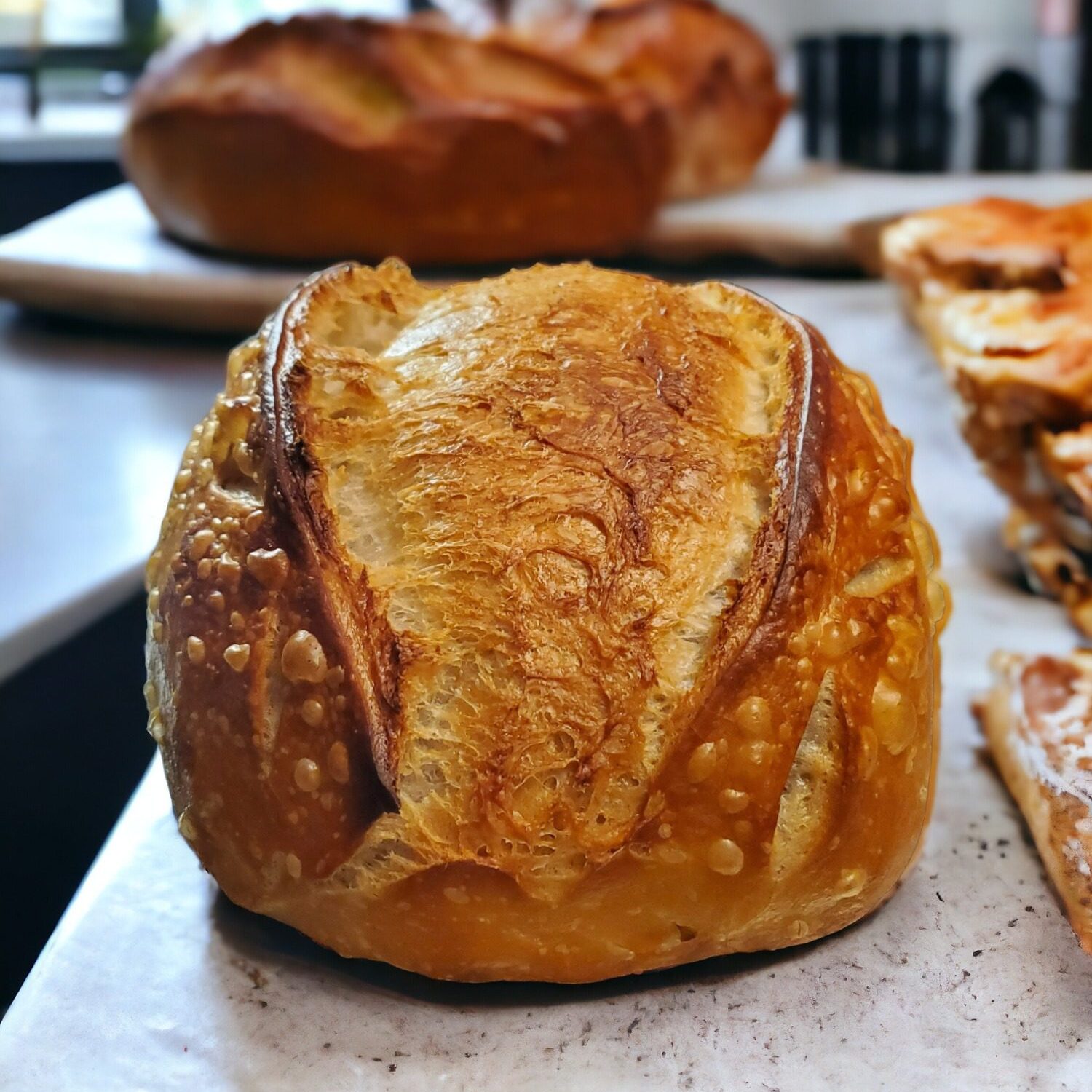
👉 Includes my overnight option for busy schedules
There was a time when I stood in the bread aisle at the grocery store reading ingredient labels and thinking… this can’t be right.
Why does bread need this many additives? Why are there ingredients I can’t pronounce?
That was the beginning of my journey toward making a simple sourdough bread recipe I could feel good about serving.
I didn’t start baking because it was trendy. I started because I wanted simple bread. Flour. Water. Salt. Something I could feel good about feeding my family.
It took trial, error, and hundreds of loaves to refine.
There were flat loaves. Dense loaves. Loaves that looked beautiful on the outside and gummy in the middle. (I have the photos to prove it 😅)
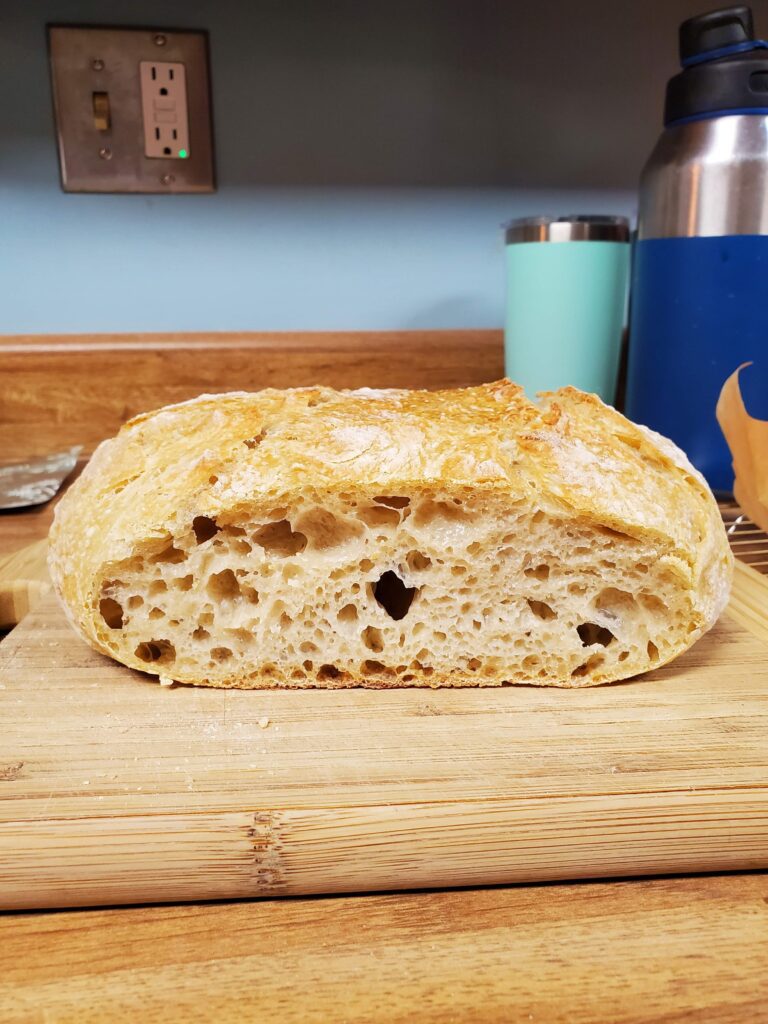
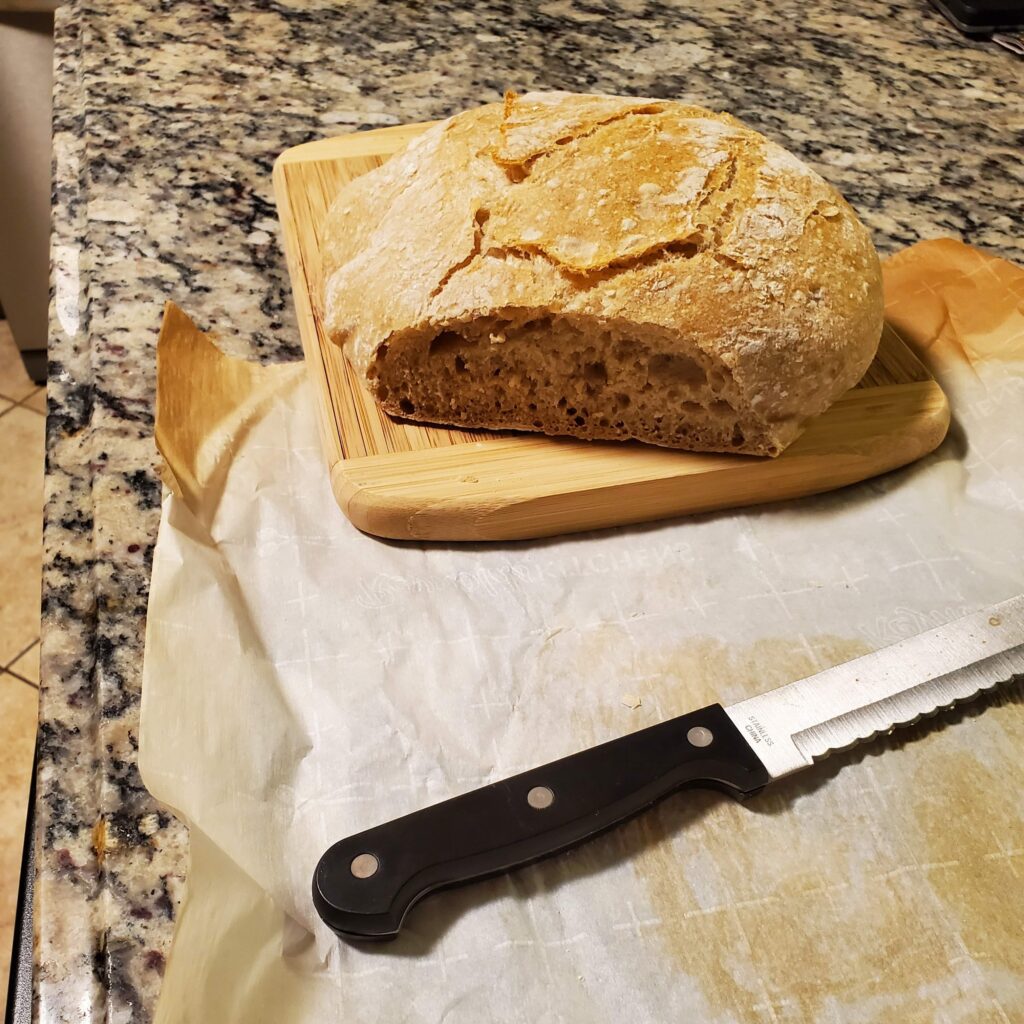
But eventually… I pulled one perfect golden loaf out of the oven.
And after that, there was no stopping me.
I now bake around 60+ loaves a week in my home kitchen, so this isn’t just a weekend experiment — this is the method I rely on consistently.
Simple Sourdough Bread That Actually Fits Real Life
So, if you’re looking for a simple, dependable sourdough recipe without a million complicated steps, you’re in the right place.
This is the sourdough recipe I come back to again and again. It’s made with just flour, water, salt, and sourdough starter, and it produces a loaf with a crisp crust, soft interior, and plenty of structure.
But here’s the thing I’ve learned after baking thousands of loaves:
The recipe itself isn’t the hardest part of sourdough.
It’s learning how to recognize a strong starter, understand fermentation, and know when your dough is actually ready to move to the next step.
I’ve made plenty of flat loaves, dense loaves, gummy loaves, and loaves that looked beautiful on the outside but were definitely not what I was hoping for inside. 😅
Over time, I learned that a few small changes to my process made a much bigger difference than buying another piece of equipment.
This recipe reflects the way I bake sourdough in my own kitchen today.
Before You Start: Your Starter Matters
One of the biggest changes I’ve made to my sourdough over the years is how I prepare my starter before baking.
I use a double feeding method the day before I mix my dough. Instead of feeding my starter once and using it, I feed it twice—with no discard between feedings.
The first feeding gives the starter a boost, and the second feeding builds the amount I need for baking the following morning.
For a typical home baker, the basic idea is:
First feeding: 1:1:1
Second feeding: 1:4:4
No discard between feedings
This helps me build a predictable, active starter that’s ready to go when I mix my dough.
If your starter has been sluggish, isn’t rising consistently, or you’re constantly wondering “Is my starter actually ready?”, this is something I highly recommend trying.
👉 Want to see exactly how I do my Double Feed Method? I break it down step-by-step here:
The Double Feed Method: My Sourdough Starter Prep Routine.
And if you don’t want to do the math yourself, I created a Double Feed Calculator that calculates your feedings for you.
👉 Get the Double Feed Calculator →
🍞 Want the whole process at a glance?
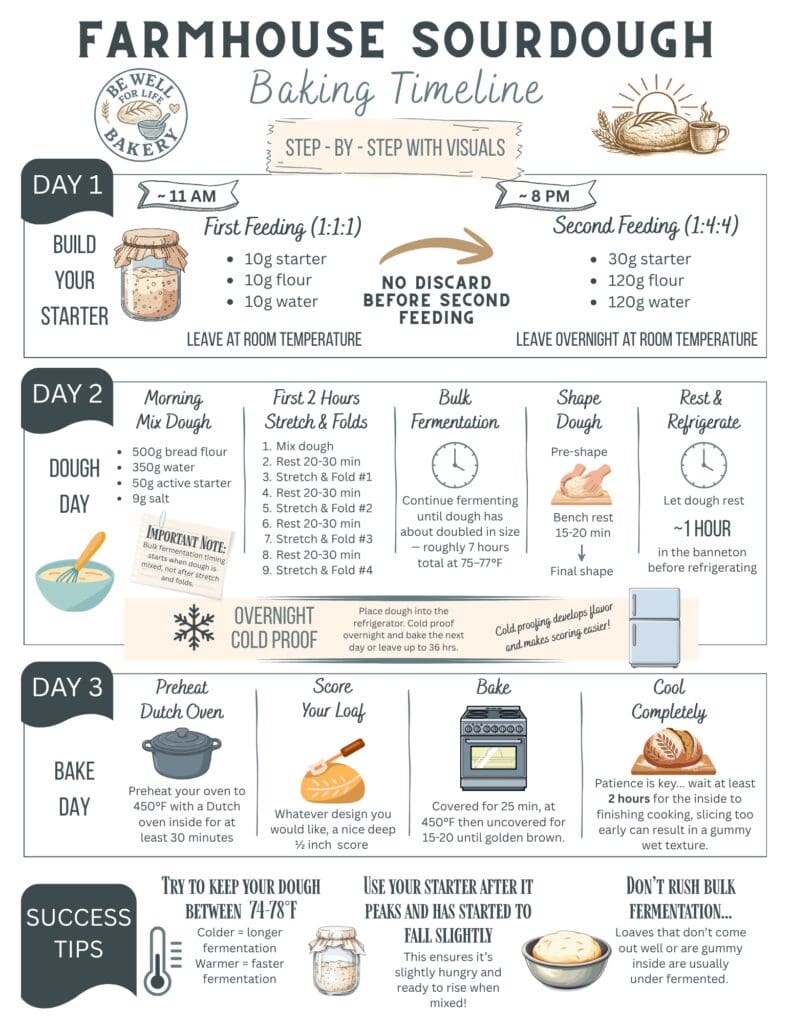
GET THE FREE BAKING TIMELINE
Enter your email below and I’ll send the printable version straight to your inbox. (Created by me…not AI 😉)
"*" indicates required fields
My Simple Farmhouse Sourdough Bread
This recipe makes one approximately 800g baked loaf (dough at shaping will weigh about 900g).
Ingredients
- 50g active sourdough starter
- 350g water
- 500g bread flour
- 9g fine sea salt
Hydration: ~72%
STEP 1 — MIX THE DOUGH
Mix
Add 50g active sourdough starter and 350g water to a large mixing bowl…I love using a clear container, so you can see the rise.
Stir until the starter is mostly dispersed.
Add:
- 500g bread flour
- 9g salt
Mix until all of the flour is incorporated and there are no dry spots.
Don’t overmix. You’re not trying to develop a windowpane at this point. You simply want everything combined into a shaggy dough.
Cover and let the dough rest for 30 minutes.
STEP 2 — STRETCH & FOLDS
Build Dough Strength
After the 30-minute rest, begin your stretch and folds.
Perform 4 sets of stretch and folds, approximately 30 minutes apart.
For each set:
- Grab one side of the dough.
- Gently stretch it upward.
- Fold it over toward the center.
- Rotate the bowl and repeat around the dough.
As you work through the sets, you’ll notice the dough becoming smoother, stronger, and more elastic.
Remember:
Your stretch-and-folds are part of bulk fermentation.
You don’t do your stretch and folds and then start your clock for bulk fermentation.
Bulk fermentation begins when you mix the dough.
That’s an important distinction—and one that causes a lot of confusion for newer bakers.
STEP 3 — BULK FERMENTATION
Don’t Watch the Clock. Watch the Dough.
This is probably the most important part of the entire recipe.
Once you’ve finished your stretch and folds, cover the dough and let it continue fermenting at room temperature.
My ideal dough temperature during bulk fermentation is around 74–76°F.
At that temperature, my dough is typically ready to shape around the 7-hour mark, but your dough may take more or less time.
That’s why I don’t recommend using a specific number of hours as the only indicator.
Instead, look for:
- About 75-100% increase in volume
- A slightly domed surface
- Bubbles along the sides of the container
- A lighter, airier feel
- A noticeable jiggle when you move the bowl
- Dough that feels stronger and holds its structure
STEP 4 — SHAPE
Shape Your Loaf
Once your dough has reached the right stage of fermentation, gently turn it out onto a lightly floured surface. If you’re unsure of what your dough should look like, 7 hrs is a good starting point to try shaping.
I use a fairly specific shaping method because I want to create enough surface tension to encourage the loaf to rise upward rather than spread outward.
Gently stretch the dough into a triangle, with the point facing away from you.
Then:
- Fold the two bottom corners toward the center.
- Pull the top point down over those folds.
- Fold the two sides inward toward the center.
- Starting from the bottom, roll the dough up onto itself.
- Gently press out any large air pockets without compressing the dough.
- Place the dough seam-side up into a well-floured banneton.
After placing the dough in the banneton, the seam may naturally start to open because of the tension created during shaping. That’s completely normal. Wait about 15 minutes before trying to pinch the seam closed again. This gives the dough time to relax, and the seam should close and hold much better.
You can watch a demonstration of this technique below.
STEP 5 — REST + COLD PROOF
Give Your Dough Time to Develop
After placing in the banneton, I like to cover and rest the dough an additional 1-1.5 hours in the basket before moving to the fridge for overnight cold proof. So total time from mixing until the dough is put in the fridge is usually 8-8.5 hours.
(I use disposable shower caps for covers — simple and effective.)
Why cold proof?
The cold slows fermentation while allowing the dough to continue developing flavor and structure.
It also makes the dough much easier to score and transfer directly into the oven.
I bake my dough straight from the refrigerator.
No need to bring it back to room temperature.
STEP 6 — BAKE
Bake Your Sourdough
The next day, preheat your oven to 450°F with your Dutch oven inside.
I like to preheat for 30–45 minutes so the Dutch oven is thoroughly heated.
When you’re ready to bake:
- Remove your dough from the refrigerator.
- Turn it onto parchment paper.
- Score the top with a razor.
- Carefully transfer it into the hot Dutch oven.
- Optional: Add 1–2 ice cubes under the parchment for additional steam.
Bake:
25 minutes covered
Then remove the lid and bake for another:
15–20 minutes uncovered
You’re looking for a deeply golden-brown crust.
TIP: If your oven tends to brown the bottom of your bread too aggressively, place a sheet pan on the rack below your Dutch oven.
STEP 7 — COOL
Please Don’t Cut It Yet. 😂
I know.
You just baked a beautiful loaf and it smells amazing.
But let it cool.
I recommend waiting at least 2 hours before slicing, and honestly, I prefer giving my loaves even longer when I have the patience.
The inside of the loaf continues to set as it cools. Cutting too soon can leave you with a gummy or compressed crumb—even if the bread was properly fermented and baked.
🌙 Overnight Option (Perfect for Busy Schedules)
Short on time during the day? You can make this dough at night instead. If you plan to mix dough at night, make sure you don’t forget to feed your starter in the morning so it’s ready to go 😉. If you’re using my Double Feed Method, you’ll prepare your starter the day before so it’s ready to mix with that evening.
This option lets you do the mixing and bulk fermentation overnight, then shape and refrigerate your dough in the morning.
Example Schedule:
- 9:00 PM – Mix dough
- 9:20 PM – Stretch & fold
- 9:50 PM – Stretch & fold
- (Optional) 10:10 PM – One more stretch & fold
👉 Two sets is perfectly fine if you’re tired
👉 Three quick sets (20 minutes apart) is ideal if you have time
💤 Overnight Ferment
- Cover the dough and place it somewhere cool in your home
- Let it ferment overnight for 8–9 hours
Need a longer window (up to 10 hours)?
→ Use cold water when mixing
Using room temp water?
→ Stick closer to 9 hours to avoid over-fermenting
🌅 In the Morning
- Shape the dough
- Place in a banneton
- Transfer to the fridge
Done in just a few minutes.
❄️ Bake on Your Schedule
Your dough can now rest in the fridge until you’re ready to bake.
- 12–18 hours → Mild flavor, strong oven spring
- 24 hours → Slightly more sour, excellent structure
- 36 hours → Fuller flavor, slightly looser dough
- Up to 48 hours → Possible, but the dough may become more fragile and the results less predictable
Tools I Personally Use
Instead of listing random equipment, here’s what I actually reach for:
- My go-to baking tools can be found in my Amazon storefront:
👉 Amazon Store - I also offer my own organic sourdough starter (with tips + this printed recipe included):
👉 Organic Sourdough Starter
These are the tools I rely on week after week while baking dozens of loaves — nothing fancy, just what works.
Final Thoughts
Sourdough doesn’t have to be complicated.
You don’t need a dozen special techniques or expensive equipment. What made the biggest difference for me was learning to understand my starter, control fermentation, and pay attention to what my dough was actually telling me.
This recipe is the foundation I use again and again—and once you get comfortable with it, you can start experimenting with different flours, inclusions, shapes, and flavors.
If you make this loaf, I’d love to see it!
Leave a rating below or drop a comment and tell me how it turned out. 🧡
Continue Your Sourdough Journey
👉 How to Get a Better Rise in Sourdough Bread
Discover the simple changes that can dramatically improve oven spring, loaf height, and crumb structure—without changing your recipe.
👉Beginner Sourdough Mistakes: Why Your Loaf Is Flat, Dense, or Gummy (And How to Fix It)
Common reasons sourdough loaves turn out flat, dense, or gummy — and how to fix them.
👉My Exact Sourdough Baking Schedule (How I Make It Work In My Home Bakery)
See how I manage fermentation, shaping, and baking when making dozens of loaves each week.
If you try this recipe, I’d love for you to leave a rating below ⭐⭐⭐⭐⭐— it helps others and supports my small bakery.

Simple Farmhouse Sourdough Bread Recipe
A beginner-friendly traditional sourdough loaf made with just flour, water, salt, and starter.
Servings: 1 loaf
Equipment
- 1 Clear Container my favorite for mixing and bulk fermentation
Ingredients
- 50 grams active sourdough starter
- 350 grams warm water
- 500 grams bread flour
- 9 grams sea salt
Instructions
- Mix the Starter: In a large mixing bowl, combine the active sourdough starter and warm water. Stir until mostly dissolved.
- Mix the Dough: Add the flour and salt to the starter, and mix until no dry flour remains and a shaggy dough forms.
- Rest: Cover the bowl and let the dough rest for 30 minutes. This allows the flour to fully hydrate and begins gluten development.
- Stretch & Folds: Over the next 90 minutes, perform 3–4 sets of stretch and folds about 30 minutes apart. To do this, gently lift one side of the dough, stretch it upward, and fold it over itself. Rotate the bowl and repeat 3–4 times per session. The dough will become smoother and stronger with each set.
- Bulk Fermentation: After the final stretch and fold, cover the dough and allow it to rise at room temperature until roughly doubled in size. This typically takes 6–8 hours depending on your kitchen temperature. The dough should look slightly domed with visible bubbles along the edges.
- Shape & Cold Proof: Turn the dough out onto a lightly floured surface. Gently shape it into a round by folding the edges inward and creating surface tension. Place seam-side up in a floured banneton or towel-lined bowl. Cover and refrigerate overnight (12–24 hours).
- Bake: Preheat your oven to 450°F with a Dutch oven inside for at least 30 minutes. Turn the dough onto parchment paper, score the top with a sharp blade, and carefully place it into the hot Dutch oven. Bake covered for 25 minutes, then uncovered for 15–20 minutes until deeply golden brown.
- Cool: Transfer the loaf to a wire rack and allow it to cool completely (at least 1 hour) before slicing. Cutting too soon can result in a gummy interior.
Notes
- If your kitchen is warm, fermentation may move faster.
- If cold, allow additional time.
- Dough should feel airy and slightly puffy before shaping.
- For best results, use an active, bubbly starter at peak rise.
🌙 Overnight Option (Perfect for Busy Schedules)
Short on time during the day? You can make this dough at night instead. If you plan to mix dough at night, make sure you don’t forget to feed your starter in the morning so its ready to go 😉. Example Schedule:- 9:00 PM – Mix dough
- 9:20 PM – Stretch & fold
- 9:50 PM – Stretch & fold
- (Optional) 10:10 PM – One more stretch & fold
👉 Three quick sets (20 minutes apart) is ideal if you have time
💤 Overnight Ferment
- Cover the dough and place it somewhere cool in your home
- Let it ferment overnight for 8–9 hours
→ Use cold water when mixing Using room temp water?
→ Stick closer to 9 hours to avoid over-fermenting
🌅 In the Morning
- Shape the dough
- Place in a banneton
- Transfer to the fridge
On sale products
-
Cropped Tea-Shirt *Closeout Sale*
Original price was: $19.99.$5.00Current price is: $5.00. -
Eat Real Bread Hoodie *Closeout Sale*
Original price was: $34.99.$10.00Current price is: $10.00. -
Eat Real Bread T-Shirt *Closeout Sale*
Original price was: $19.99.$5.00Current price is: $5.00. -
Happy Thoughts and Sourdough Hoodie *Closeout Sale*
Original price was: $34.99.$10.00Current price is: $10.00. -
Happy Thoughts and Sourdough T-Shirt *Closeout Sale*
Original price was: $19.99.$5.00Current price is: $5.00.





74 responses to “Simple Farmhouse Sourdough Bread Recipe”
-

This recipe is perfect and very easy to follow. Been baking sourdough for a few years now – 70% hydration is perfect for me. If you are new to sourdough baking, this is a great place to start. I’ve gifted loaves to a few people from this recipe and it’s been a hit every time.You get a very nice crumb from this and have dough that is easy to handle.
-
Thanks for trying the recipe! I’m so glad you enjoyed it 😊.
-
-
Thanx for the simple and clear recipe! I want to use it but I wander if any changes are necessary in case my flour is a mix of Wholewheat and All purpose (40%-60%). Please advise
-
Hi John, I have not made this using whole wheat flour but as a general rule of thumb, whole wheat flour usually requires 5% to 15% more water than white flour. So if your whole wheat is 40% (200g), I would increase the water for that flour respectively. So 140g water for that flour (40% of the total water) and then add anywhere from 5-15% on to that, so 7-21g of extra water. I guess I would start somewhere in the middle and adjust form there. Hope that helps! Let me know how it turns out 🙂
-
Only 50 g of starter, I’ve been using 120 g- am I missing something. I’m going to do this recipe and see but what can you tell me about such a lower starter amount for me?
-
Hi Debbie, I wrote a little more about it in my how to get a better rise blog post. But here is a copy of the section from that post:
3. My Dough Formula (Why I Use Less Starter)
Another thing that plays a big role in how my bread rises is the amount of starter I use in my dough and the quality of flour I use.Most traditional sourdough recipes use around:
👉 100g of starter
But in my kitchen, I use:
👉 50g of starter per loaf
Why I Use Less Starter
Using less starter slows fermentation slightly and gives the dough more time to develop strength.This helps:
✔ improve structure
✔ build stronger gluten
✔ create a better overall riseIt also gives you more control over fermentation, especially when you’re baking consistently.
What This Means for Your Dough
When you use less starter:fermentation takes a little longer
the dough develops more gradually
the final loaf has better structure and lift
This is a small adjustment, but it makes a noticeable difference in the final result.Flour Matters Too
I always recommend using a strong bread flour.Bread flour has a higher protein content than all-purpose flour and makes a big difference in structure and rise. My personal favorite is King Arthur Baker’s Classic Organic.
I don’t believe there is one correct amount of starter, it all comes down to personal choice and time. 50g is going to take quite a bit longer to ferment but I feel like it develops stronger dough for me.
-
-
-
Is it the same ingredients if I were to use a rye starter
-
Hi! 1/3 of the flour in my starter is always rye, so I don’t think you will have to change anything. If yours is 100% rye it may ferment a little faster and absorb slightly more water, but since the starter amount is only 50g I think you will be fine with the recipe as is. Let me know how it turns out!
-
-
Hello! Thank you so much for taking the time to blog so it will help others. I’ve just begun this journey a couple of months ago. I have a couple of questions. Is it recommended to use a thermometer to check if the bread has reached an internal temperature. Also you may have heard using the two loaf pan method. Second one is placed on top of the pan filled with dough. Do these need to be preheated also? Thank you for your time!
-
Hi! You’re welcome 😊. I enjoy sharing what I’ve learned. I do recommend using a thermometer to check temp on your loaves, especially if you are not sure. I usually check a loaf or two on my bake days just to make sure my oven is set correctly (my bread oven has a dial so it can be off a few degrees sometimes). Anyways, once you feel like you have the right time and temp, I wouldn’t say it’s necessary to check every loaf. I like mine to be at 210 degrees Fahrenheit. I am familiar with the two pan method. From what I’ve seen it works pretty well. I would not preheat those pans. They’re not cast iron like a Dutch oven so they will heat up real quick in the oven. Good luck with your baking!
-
-
You used the term “Autolyze” incorrectly, you should have used “Fermentolyse”!
The terms “autolyse” and “fermentolyse” are sometimes used interchangeably, but they have different meanings. Autolyse is a combination of flour and water only (no salt or starter/leaven). Fermentolyse is a combination of flour, water and starter/leaven.
-
Good catch! Thanks, that’s what I get for using AI to proofread and edit my recipes 😅. I didn’t have that in my original recipe, it just said rest. I switched it back to just rest to not confuse anyone. Thanks!
-
-
When mixing the initial dough, until no flour remains, how long do you mix? I thought mixing until a window pane forms was the desired outcome strength. (I have mixed by hand, and with a mixer). I am still struggling with my loaf. I will try the smaller amount of starter next time, to see how that affects things. 🤞
-
Hi. The window pane test is a technique performed after bulk fermentation to test the strength and gluten development of your dough. It’s not for the the initial mix. For the first mix, you just want everything to be combined and no big dry spots of flour. It usually just takes a few minutes to get to that point.
-
-
What do you think about the popular ”upfront mixing” to get amore open crumb? I’ve tried to mix for longer time (5-10 min) in the beginning but it doesn’t give better result…what is your opinion?
-
Hi Yvonne, I wasn’t actually familiar with this method and had to look it up…lol. Honestly, I think it’s just a trendy thing. I don’t really see the benefit when working with regular dough. If I was doing a brioche type dough I think its important to mix more up front but as long as you get most of the dry spots out, its good to go in my opinion. When I’m doing a large bin of regular dough, it usually takes me 3-4 minutes to get everything mixed.
-
-
Hi there, thanks for sharing your recipe and experience! I just recently started my own bread journey, and was experimenting with all different techniques. So far I’m getting better in regular one day bake method- baking right after bulk fermentation. My overnight cold proofing method gave me dense and chewy crumb but slightly better flavor. My dilemma with cold proofing though is this – should I bring my dough back to room temperature before baking ( for how long hours?), or is it good to go straight from the fridge into the oven? I was following King Arthur’ recipe. Thanks for your response!
-
Hi Barno,
Thanks for checking out my blog, happy to help! That’s interesting that it came out dense and chewy after cold proofing. Did you do the same bulk fermentation as always and then just move it to the fridge rather than baking? I’ve seen issues where people think the cold proof replaces bulk fermentation but it doesn’t, not saying you did that but just wanted to check. For this recipe, I typically bulk ferment for about 8 hours depending on my house temperature and then cold proof for about 16 hours. I bake straight from the fridge and don’t let it come to room temp. That’s what I would recommend doing. Hopefully it goes well for you next time!
-
-
Can I add bit of cheese and jalapeño in this loaf?
-
Absolutely! This is the same recipe that I use for all my inclusion loaves. I usually add inclusions during shaping by stretching out the dough and rolling in, but you could also add during the last couple stretch and folds. Delicious choice by the way 😉. Happy baking!
-
-
Cuando uso papel pergamino se pega mucho al pan, luego es muy difícil quitarle el papel después de horneado el pan.
-
It could be the brand of parchment paper you are using, some don’t work well at high heat even if they say they do. I’ve had a couple bad experiences… I’ll try to link the two brands I use here: https://amzn.to/4v7Oi8k and https://amzn.to/4fdDi4T . My suggestion would be to try a different brand than you are using, and hopefully that helps!
-
-
⭐️⭐️⭐️⭐️⭐️
-
Mahalo for this recipe…I am trying it tonight..
-
I’m pretty new to sourdough, I had a few good loaves, then every one after that the last 5-6 goes has tanked.
Last week I tried this recipe, and it turned out great! I was unsure as usual as I’ve tried so many beginner recipes, but this one actually worked. I’ve currently got a double batch BF at the moment to make a loaf for me and for my friend.
I’m still getting the hang of things and will BF it overnight on the bench (pretty cold where i am- I’m expecting 12hrs+).
I’m glad to have found this recipe and if all goes well will use it endlessly!-
Amazing! I’m happy you found me and I hope your current batch turns out great! Let me know if you run into any issues or have any questions 😊.
-
-
Hi. From South Africa. Can I use cake flour instead of bread flour. Please advise
-
Cake flour has a very low protein content compared to bread flour. Cake is about 7-9% and bread flour is 11-14%. You can try it, but your dough is probably going to be hard to work with and not have much strength because of the low amount of gluten. Most likely it will not have the same chewy bread texture and not rise very well.
-
-
Hi there, thank you for sharing your recipe, you mentioned 1/3 of flour is always rye flour, is that for feeding only or do you also include 1/3 rye in the final dough? Thank you!
-
Hi! The 1/3 rye is only for feeding my starter. I don’t include any in my final dough when I’m making bread.
-
Can I use fresh ground whole wheat flour in place of the rye flour in my starter and if I do will have a similar response?
-
Hi! Yes, you can use whole wheat flour to produce a similar effect but it won’t be quite the same. Here’s a overview of the differences:
Fermentation Speed & Activity: Rye flour contains higher concentrations of wild yeast and enzymes that break down complex starches into simple sugars, causing a faster, more explosive rise. Whole wheat also ferments quickly, but rye is more reliable for jump-starting sluggish starters.
Nutrient Density: Rye is naturally richer in minerals (like magnesium and iron) than wheat, providing optimal food for the microbial ecosystem.
Acidity: Starters fed with rye tend to produce a stronger, tangier flavor due to increased acetic acid production, while wheat offers a milder, sweeter, and nuttier profile.
Handling: Rye has lower gluten content and contains pentosans (plant gums), which makes rye starters noticeably thicker, stickier, and more gummy. Whole wheat creates a stiffer, less sticky starter with higher gluten strength.-
Hi! Do you use whole-grain or light rye flour?
-
I use a medium rye flour. This one to be exact Rye Flour
-
-
-
-


Thank you for sharing your recipe!!
Do you weigh your loaves before shaping? And if so, what is your average pre-baked weight of each loaf?
-
Hi! You’re welcome 😊. Yes, I separate and weigh them after bulk fermentation, then I shape them all. The shape weight is about 902g-904g. Let me know if you have any other questions.

I have been making sourdough for several years now. Early results were pretty mixed to say the least. I hesitate to say I have cracked it now, but mostly the results are fine. After trying every bit of advice I have come across this is my current regime. I do the initial mix in a mixer with a dough hook, for about 5 mins, nothing like as long as I do for standard yeast loaf, which I also make as my wife is not a fan of sourdough. So the mixer just gets everything well mixed. I don’t hold back the salt as I used to, just chuck everything in together. I use 100% milk as the liquid, or buttermilk if I have remembered to buy some. The texture is much nicer with milk. My starter lives in the fridge and is brought out and fed 1:3:3-ish the day before I want to make dough. I don’t have any discard as I only keep 30 g. Then I feed with 50g rye, and 50g water. So I have 130 g. I use 100g in my loaf and 30g goes back in the fridge. I BF all day and after putting in the banetton I overnight it in the fridge. I have been using a tin lately to make loaves with slices that fit the toaster! I have a pizza steel in my top (non fan) oven, and use this with a tin of boiling water in there too.

I just the past couple of days found your Instagram and this blog. want to say thank you for sharing and taking time for other bakers.
Ive been baking now for about a year . My loafs with the inclusions seem ok, but my bread is always gummy inside and Ive tried several
methods but none seem to work . I can’t seem to get it right . Thanks
-
Hi Robin. You’re welcome! I would love to try and troubleshoot your process a little more. What do you bake in? Dutch ovens? What is your recipe breakdown? What does your starter feeding and care look like? Feel free to email me back at info@bewellforlifestore.com and I’ll see if I can help 💗. Thanks for following along!

Great explanation! Easy to follow!!
-
Thanks! I’m glad you enjoyed it! I hope your bread turns out great 😊.

Thank you for explaining everything so thoroughly and from a scientific perspective in layman’s terms… It really helped with understanding all the processes. I have often read about having a higher ratio of flour in the starter than water. Is that something that you find useful and if so, what percentage would you increase the flour? Thanks, 🙏 Laura 😊 (I don’t have a website)
-
You’re welcome! I have never felt the need to use more flour than water. I always go by weight when feeding and use equal amounts of both. If someone was using measuring cups though I could see the reasoning to use more flour than water because the water weighs more so you would need more volume of flour to match it. I have read about using more flour by weight to stiffen the starter or make it less sour. I’ve never tried that technique myself…If my starter is getting weak or thin I just add in extra feedings rather than going 24 hours between. If you wanted to try a higher flour ratio, you could do 1:2:1. This will slow down the fermentation since it has more food to eat. Just keep in mind, this is considered a stiff levain and most recipes are written for a standard 1:1 ratio starter so your dough outcome maybe slightly different if you use this instead of your regular starter mix to make bread. Happy Baking!
Hi Kristi, I generally fully incorporate all the flour into my first mix… instead of having a shaggy dough waiting 30 minutes and then fully incorporating. Is that not advisable and if not. could you please explain? Thanks, Laura. 🙏🏼
-
Hi! Yes that’s totally fine, I usually incorporate it as much as possible as well. Some flours absorb water more quickly than others so I didn’t want to give the impression it should be nice and smooth right away, but yes fully incorporated is perfect 👍.

Sunt fericita ca am gasit acest site de unde pot sa ma inspir in a face paine cu maia. De putin timp am inceput cu obtinerea maielei si apoi cu obtinerea painii. Nu sunt incantata de ceea ce am obtinut. Painea mea a iesit gumoasa la interior si nu imi dau seama de ce. Daca poti sa-mi dai niste sfaturi cu mii de multumiri!
-
Hi! I’m glad you found me as well 😊. It may take a bit of troubleshooting to figure out exactly why its gummy, but check out this article I posted. Beginner Sourdough Mistakes: Why Your Loaf Is Flat, Dense, or Gummy (And How to Fix It) Also, feel free to email me with any specific questions!

Thank you so much for sharing a beautiful and tasty recipe.
I was strangling to bake real sourdough bread. Now I will follow this steps. I hope soon my breads will similar to yours. Thanks again!
-
You’re welcome 😊. Good luck with your baking!

Hi, I’ve been making these loaves successfully in my Dutch oven.
To make a different sized loaf I’d like to try a Le Creuset porcelain baker. Have you tried this?
-
Hi! I have not tried that type of pan. I’m sure it would work as long as the size is right for the loaf. I’ve heard good things about that brand and the quality of their pans.

Whenever I try doubling the bread recipe it does not go well. If I’m going to make sourdough bread I would rather make 2 loaves. Can you please share recipe for 2 loaves?
Thank you!
-
Hi, sure. It would be the exact same recipe. You just double all the ingredients, so: 1000g flour, 700g water, 100g starter, 18g salt. When you go to shape it after bulk fermentation, each loaf will weigh approximately 900g. Hope that helps. Happy Baking!

Thank you for explaining everything. Do you strech and fold in the round 6 qt container or you use it only for final fermentatio? I am looking for a container for 4-6 loafs
-
Hi! I do stretch and folds in the round container, but it only fits 3 loaves max (and that’s pretty full. It wouldn’t work for more, unless your loaf size is quite a bit smaller than mine, my loaves are 900g at shaping. If your loaves are close to the same size, for 4-6 loaves I would recommend this one: 12×18 container . Just a heads up, the lid is sold separately… lid

Hi from Denmark. How warm is your water?
Majbrith
-
Hello! It depends on the time of the year. But it ranges from about 70°F – 85°F. I use the cooler water in the summer and warmer in the winter.

is it ok for my starter to be kept in the fridge until i take 10g from it for the first feed?
-
Yes, that would work just fine 👍.
-
thanks. I’m confused by this PDF – at what point do i disguard? https://bewellforlifestore.com/wp-content/uploads/2026/08/Baking-Timeline-791×1024.jpg
-
Hi! You would discard whatever you don’t need after taking the starter out for making bread in the morning. I only use this double feed method the day before mixing dough. If I am not making bread, I feed my starter once a day at night, always discarding before feeding. Usually only leaving about 20-30g in the jar after discard. Hopefully that helps! So, just to clarify, you would discard after taking out what you need for bread and than refeed at your normal schedule and size.
-
Hi there, thank you so much for all that you do and taking the time to answer all of our questions.
I read through all the questions in hopes of finding an answer to this one so I wouldn’t ask a question that’s already been answered.
I’d like to add one additional question to this topic: does the double feeding result in unnecessary amounts of discard? If so, how do I keep that to a minimum? I feel like I’ll be using a lot of flour when using this method.
Thank you in advance. -
Hi! No problem. Glad you are finding my content helpful 😊. The double feed method does work best for large amounts of starter but you can scale it down pretty small so you are not wasting a lot. If you just wanted to make a loaf or two. It would look something like this: First feed- 7g starter, 7g flour, 7g water. 2nd feed- ~22g starter(from the morning), 88g flour, 88g water. This would give you a total of 200g of starter to use the next day. Hope that helps answer your question! It does get tricky going lower than that because your first feed is such small amounts so I probably wouldn’t go lower than 200g overall but you could always try it and see how it works 😉. The calculator I built does all the math for you so you can simply put in how much starter you want at the end and it will give you all the feeding amounts! If you’re interested, here’s the link Double-Feed Calculator
-
-
-


Thank you for your clear explanations. I have only been doing sourdough for a few months but have baked my own bread for more than 30 years so it is quite a change! I am curious about you stating to look for the dough doubling in size. I always do that with ordinary dough but have been following the dough temping methods out there and they only advise doubling in size when the dough rises very slowly and is quite cool (ie around 20 degrees after stretch and folds). Yesterday my dough was 25 degrees and there a 40% rise is recommended.
that said I am not having great results – mainly over proofing (busy life miss the target rise) and I get poor oven spring with loaves going out rather than up. I am also struggling to find strong bread flour equivalents here in Switzerland – there is lots of amazing flour but mostly dense wholewheat and mixes of spelt and other grains. I am finding it hard to find a flour that allows for a really stretchy dough/gluten development.
Anyway my main question is – your doubling as a measure of proofing being done is puzzling me as whenever this has happened to me, the dough is a sloppy mess and hard to shape and very overproofed
-
Hi! I had to check my answer with Google for a litle help with your question. I was pretty sure I knew the answer, but I just wanted to check and I didn’t know the best way to explain it. But I was right on target. The starter amount is going to make a big difference in whether you overproof or not. I only use 50 grams of starter in my recipe which is a 10% inoculation, most sourdough recipes call for 20% or more. Because of this, the bulk fermentation is very different. I’m going to copy and paste exactly what Google answered to help explain it better.
1. The Acid vs. Gas Timeline (The Main Factor)
Over-proofing isn’t just about the dough getting too big; it’s about acid buildup breaking down the gluten structure.
• At 20%+ Inoculation: You introduce a massive army of microbes right from the start. They produce gas quickly, but they also produce lactic and acetic acids rapidly. By the time the dough expands by 50% to 100%, the high acid concentration has severely degraded the gluten. The dough becomes soupy, sticky, and collapses.
• At Your 10% Inoculation: You start with a much smaller microbial population. They have a massive “feed” of fresh flour to consume. Because it takes them much longer to multiply, the yeast has time to steadily pump gas into the dough and stretch it to double its size before the bacteria can produce enough acid to weaken the gluten network.
2. Temperature Correlation
The final volume of bulk fermentation is intimately tied to temperature.
• Warmer dough (e.g., 26°C / 78°F or higher) ferments so fast that bakers must stop bulk fermentation early (around a 30% to 50% rise) because the dough will rapidly sprint into over-proofed territory while sitting on the counter during shaping.
• If you are combining 10% inoculation with a cool-to-moderate room temperature (like 20°C / 68°F), the fermentation curve is gentle and slow. Pushing the rise to a 100% increase (doubling) is perfectly safe because the dough isn’t a ticking time bomb of heat and acid.
3. Flour Quality & Protein Strength
You also correctly guessed that flour choice plays a role. A strong, high-protein white bread flour can withstand a massive volume expansion and a longer fermentation time because its gluten network is incredibly resilient. If someone is using a weaker all-purpose flour or a high percentage of whole grains, their gluten matrix will degrade much faster, forcing them to shape the dough long before it ever has a chance to double.So, my suggestion to you, especially with a busy schedule would be to try my farmhouse sourdough bread recipe if you haven’t yet, and see how that works out for you. If that doesn’t help, it might be the flour. I know you mentioned having a hard time finding a good strong flour, which could also be a big part of the problem. Hopefully this helps! 👍

Hi, thank you for this recipe!
Please could you provide temperatures and timings for an open bake using this recipe.
Thank you!
-
When I used to open bake in my kitchen oven before getting a bread oven I would bake at 445 degrees Fahrenheit for 20 minutes with steam, remove them water and then bake for 12 more minutes. Then rotate the loaves and bake until golden usually about 7-9 minutes more. All ovens heat a little differently though so you may have to play around with the temp and timing.

Hi! Thank you for sharing all this great information! Looking forward to trying your method. Would anything change if I use 25% whole wheat flour?
-
Hi! Whole wheat absorbs a bit more water than bread flour so I would increase the water amount by probably 15-25g. You’ll have to test it out a bit and see what works best for you. 👍

I’ve been making SD for about 2 years and this is my favorite go to for a great loaf of bread!
-
Thanks for the great review! I’m glad you are enjoying the recipe 😊.

Thank you for your help. This helps a lot by using less starter. In the past I have trouble with the dough being real sticky is there a trick trick to keeping workable like in the video?
John
-
You’re welcome! Using less starter and keeping fermentation at a lower temperature (around 75° F) should help your dough be a lot less sticky. When my house gets warm in the summer and in ferments too fast is does end up being much more sticky. Hopefully that helps!
Thank you for your help. This helps a lot by using less starter. In the past I have trouble with the dough being real sticky is there a trick to keeping workable like in the video?
John
Tags: Recipes

Leave a Comment